


Page 11 - Briefcase Volume 37 Number 2
P. 11
UH LAW CENTER’S 2019 SUPREME COURT UPDATE EXAMINES

        GERRYMANDERING, DOUBLE JEOPARDY AND OTHER MAJOR CASES

        University of Houston Law Center professors and members of the local   partisan gerrymandering claims are not subject to trial in a court of law
        legal community reviewed the 2018-2019 U.S. Supreme Court term   because they present a political question beyond the reach of the federal
        during a continuing legal education session.               courts.
        The opening discussion analyzed Nieves v. Bartlett and Flowers v.   Sandra Guerra Thompson, director of the Criminal Justice Institute
        Mississippi, and was led by Law Center Professor Peter Linzer and   and the Newell H. Blakely Chair, lectured on Gamble v. U.S. In a 7-2
        George “Mac” Secrest of Bennett & Secrest, PLLC.           decision the Court declined to overturn the dual-sovereignty doctrine of

        Nieves v. Bartlett involved a citizen, Russell Bartlett, who was detained   the Double Jeopardy Clause of the Fifth Amendment, reaffirming that a
        by Alaska state troopers for disorderly conduct and harassment. It   crime under one sovereign’s laws is not the same offense under the laws
        resulted in a 6-3 decision in which the court held that the presence of   of another sovereign.
        probable cause defeats a First Amendment retaliatory-arrest claim.   David Dow, the Cullen Professor of Law, presented on Timbs v. Indiana.
        “This mechanical argument, which seems to be more about the Fourth   In a unanimous decision, the Court ruled that the Eighth Amendment’s
        Amendment than the First Amendment, puts police in a position of   Excessive Fines Clause is incorporated against the states under the
        easily finding probable cause particularly when there’s a demonstration   Fourteenth Amendment’s Due Process Clause.
        going on,” Linzer said. “At that point it’s a blank check.”  Assistant Professor Emily Berman outlined Box v. Planned Parenthood
        Flowers v. Mississippi involved Curtis Flowers, a black man who had   of Indiana and Kentucky, a decision where the court upheld an Indiana
        been put on trial for murder six times. When he was convicted and   law relating to the disposition of fetal remains by abortion providers
        sentenced to death he appealed on the grounds of racial bias in jury   passes rational basis review, but declined to review whether the state
        selection. In a 7-2 decision, the Court struck down Flowers’ conviction,   may bar the knowing provision of gender, race or disability-selective
        ruling that excluding black jurors violated the Constitution.   abortions by abortion providers.
        Seth Chandler, the Law Foundation Professor of Law, reviewed two   “The Court’s opinion in this case in many ways is consistent with other
        cases involving gerrymandering, Lamone v. Benisek and Rucho v.   reproductive rights cases that have come before, in that it opted to stay
        Common Cause. Both cases ended with 5-4 decisions, ruling that   out of this particular social war issue at least for this term,” Berman said.


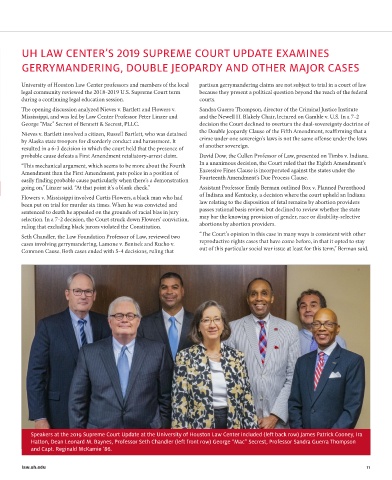
           Speakers at the 2019 Supreme Court Update at the University of Houston Law Center included (left back row) James Patrick Cooney, Ira
           Hatton, Dean Leonard M. Baynes, Professor Seth Chandler (left front row) George “Mac” Secrest, Professor Sandra Guerra Thompson
           and Capt. Reginald McKamie ‘86.


        law.uh.edu                                                                                                        11

