


Page 18 - Briefcase Volume 37 Number 2
P. 18
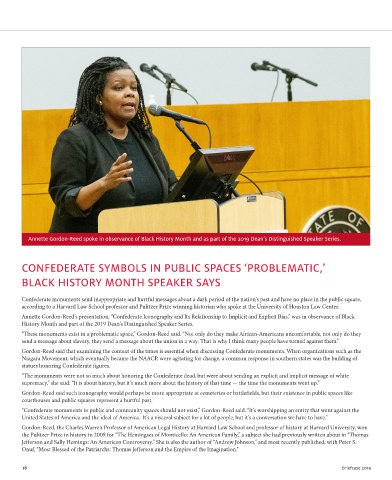
Annette Gordon-Reed spoke in observance of Black History Month and as part of the 2019 Dean’s Distinguished Speaker Series.


        CONFEDERATE SYMBOLS IN PUBLIC SPACES ‘PROBLEMATIC,’

        BLACK HISTORY MONTH SPEAKER SAYS


        Confederate monuments send inappropriate and hurtful messages about a dark period of the nation’s past and have no place in the public square,
        according to a Harvard Law School professor and Pulitzer Prize winning historian who spoke at the University of Houston Law Center.
        Annette Gordon-Reed’s presentation, “Confederate Iconography and Its Relationship to Implicit and Explicit Bias,” was in observance of Black
        History Month and part of the 2019 Dean’s Distinguished Speaker Series.
        “These monuments exist in a problematic space,” Gordon-Reed said. “Not only do they make African-Americans uncomfortable, not only do they
        send a message about slavery, they send a message about the union in a way. That is why I think many people have turned against them.”
        Gordon-Reed said that examining the context of the times is essential when discussing Confederate monuments. When organizations such as the
        Niagara Movement, which eventually became the NAACP, were agitating for change, a common response in southern states was the building of
        statues honoring Confederate figures.
        “The monuments were not so much about honoring the Confederate dead, but were about sending an explicit and implicit message of white
        supremacy,” she said. “It is about history, but it’s much more about the history of that time — the time the monuments went up.”
        Gordon-Reed said such iconography would perhaps be more appropriate at cemeteries or battlefields, but their existence in public spaces like
        courthouses and public squares represent a hurtful past.
        “Confederate monuments in public and community spaces should not exist,” Gordon-Reed said. “It’s worshipping an entity that went against the
        United States of America and the ideal of America.  It’s a visceral subject for a lot of people, but it’s a conversation we have to have.”
        Gordon-Reed, the Charles Warren Professor of American Legal History at Harvard Law School and professor of history at Harvard University, won
        the Pulitzer Prize in history in 2009 for “The Hemingses of Monticello: An American Family,” a subject she had previously written about in “Thomas
        Jefferson and Sally Hemings: An American Controversy.” She is also the author of “Andrew Johnson,” and most recently published, with Peter S.
        Onuf, “Most Blessed of the Patriarchs: Thomas Jefferson and the Empire of the Imagination.”


        18                                                                                                        Briefcase 2019

