Mount Holyoke President Danielle Holley Discusses Long Term Challenges for Civil Rights Lawyers at UH Law Center Lecture
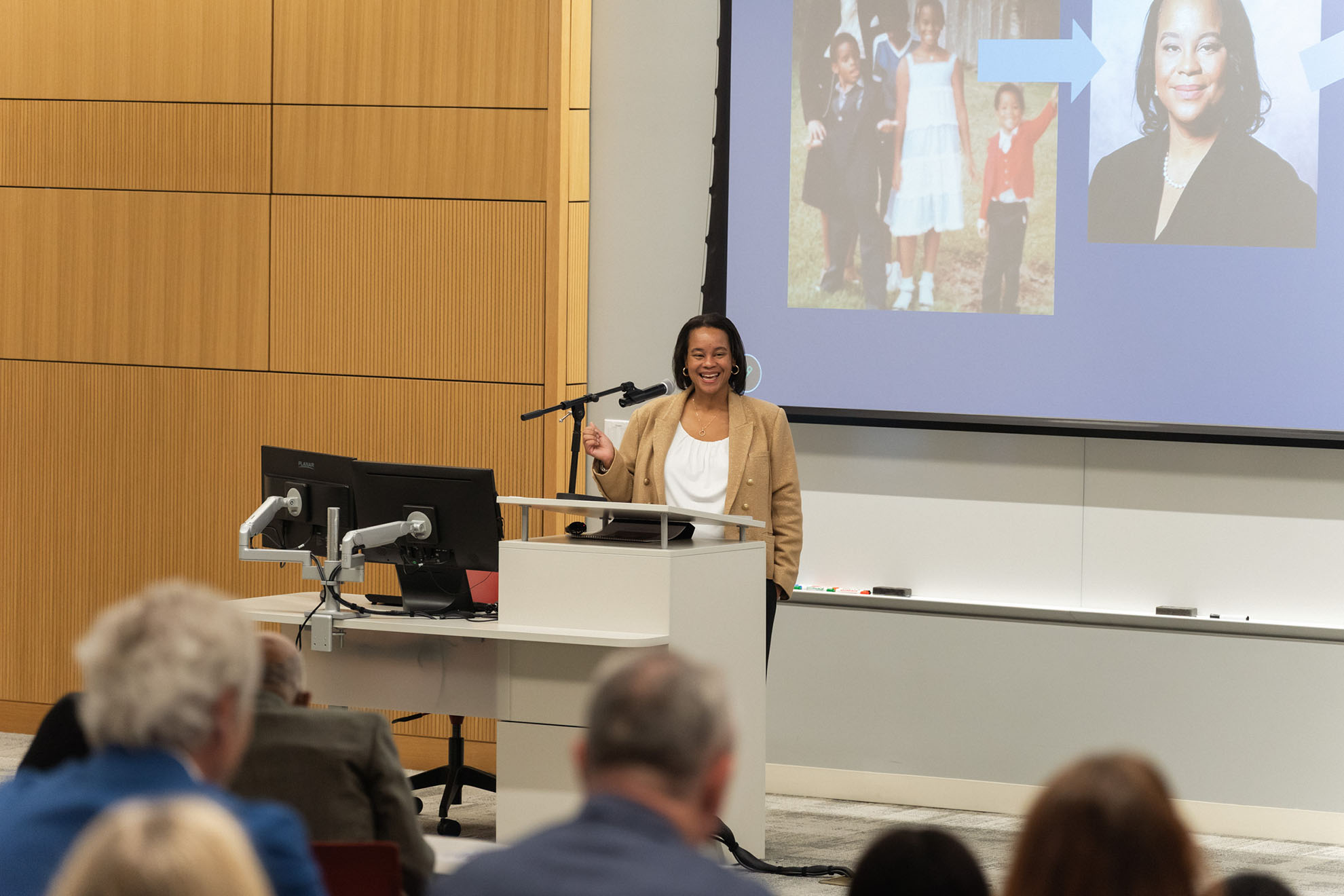
Mount Holyoke College President Danielle Holley delivers the keynote at UH Law’s 2026 Dean’s Distinguished Black History Month Lecture
Feb. 17, 2026 - Mount Holyoke College President Danielle Holley told a University of Houston Law Center audience that effective civil rights lawyering will depend on five interconnected themes: moral clarity, historical understanding, legal imagination, solidarity, and stamina.
“The first thing the future of civil rights lawyering requires is moral clarity. It requires us speaking the truth about history,” she said. “It requires legal imagination. Legal imagination means we need to think about justice as shaped not only in courtrooms, but inside law schools, firms, agencies, and the courts,”
Holley continued by describing the role of collaboration and ongoing dedication to this area of practice.
“Lawyers must be committed to justice and must be willing to challenge institutions from within and not just critique them from the outside. It also requires solidarity. No one can do this work alone. Civil rights progress has never been the work of a single community acting alone. Finally, it requires stamina. Civil rights law is not a sprint. This is a really long-term problem that we have to solve.”
Holley delivered the keynote address for the University of Houston Law Center’s 2026 Dean’s Distinguished Black History Month Lecture, “The Past, Present, and Future of Civil Rights Lawyering.” The in-person and virtual event was held in the Danny M. Sheena Courtroom of the John M. O’Quinn Law Building. UH Law Center Dean Leonard M. Baynes delivered opening remarks and introduced the keynote speaker.

Dean Baynes introduces the speaker for the evening and provides context for the evolution of legal education in the U.S. for Black lawyers.

James “Jim” Lemond (J.D. ’70), the first African American UHLC graduate, and his wife, Angela Lemond with President Holley at the event.
In his opening remarks, Baynes reflected on the importance of historical awareness and the foundations laid by early pioneers of the Civil Rights Movement, particularly in the education and practice of law.
“It’s important to know about the accomplishments of our ancestors,” Baynes said. “They succeeded with whatever struggle they had. That’s why we celebrate Black History Month - because it’s important for us to all know about our resilience as a people and the fact that there’s so much that we, as a people, have overcome and accomplished.”
Baynes also provided historical context on milestones in legal education, referencing Macon B. Allen, the first African American lawyer admitted to the bar in 1844, and the U.S. Supreme Court’s decision in Sweatt v. Painter, a landmark case that helped weaken the “separate but equal” framework in higher education and expanded access to public legal education for African Americans.
In her remarks, Holley examined how legal education, professional pathways, and institutional environments have shaped civil rights lawyering over time, noting that the law operates within broader social and structural contexts.
“The question is, where are we now? Seventy-six years after Sweatt versus Painter was decided, where do we stand in terms of black students and black law students who want to become civil rights lawyers? The doors of law schools have been open to black students since the 1964 Civil Rights Act and since Sweatt, and black lawyers have served as judges, scholars, advocates, public servants, and the president of the United States. The best current national data indicates that black lawyers make up about 5% of all US attorneys, a share that’s been essentially flat for at least a decade,” she explained.
She also discussed factors that can influence pathways into the legal profession, including educational debt, first-generation status, and the law school experience.
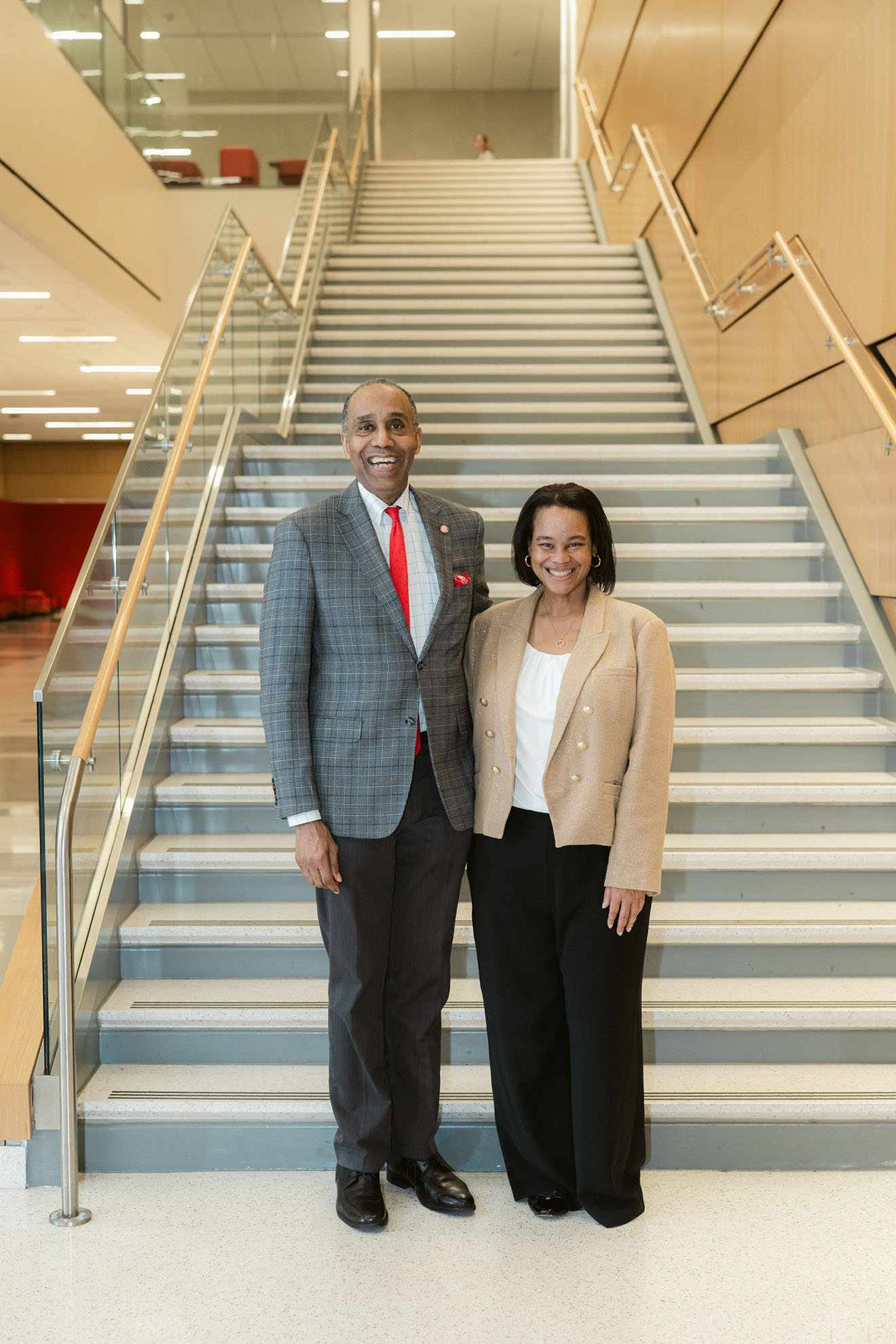
UH Law Dean Leonard M. Baynes with Mount Holyoke College President Danielle Holley at the University of Houston Law Center.
“We have barriers still to entry to the profession,” Holley said. “Many students think very carefully about whether they can afford additional education and how they navigate the law school process.”
A Houston native, Holley also shared personal reflections on her family’s longstanding ties to higher education. Her parents were both professors at Texas Southern University, and she described a unique professional milestone shared with her father.
“We actually overlapped as deans,” Holley said. “When I was dean of Howard University School of Law, he was dean of Thurgood Marshall School of Law. Together, we’re the only father-daughter pair in history to be deans of ABA-accredited law schools.”
Holley concluded by reiterating that civil rights lawyering is shaped not only by courtroom advocacy, but also by long-term institutional engagement, collaboration, and professional commitment across generations.
More photos can be found in the event gallery: https://www.flickr.com/photos/74027346@N08/albums/72177720332084733

