
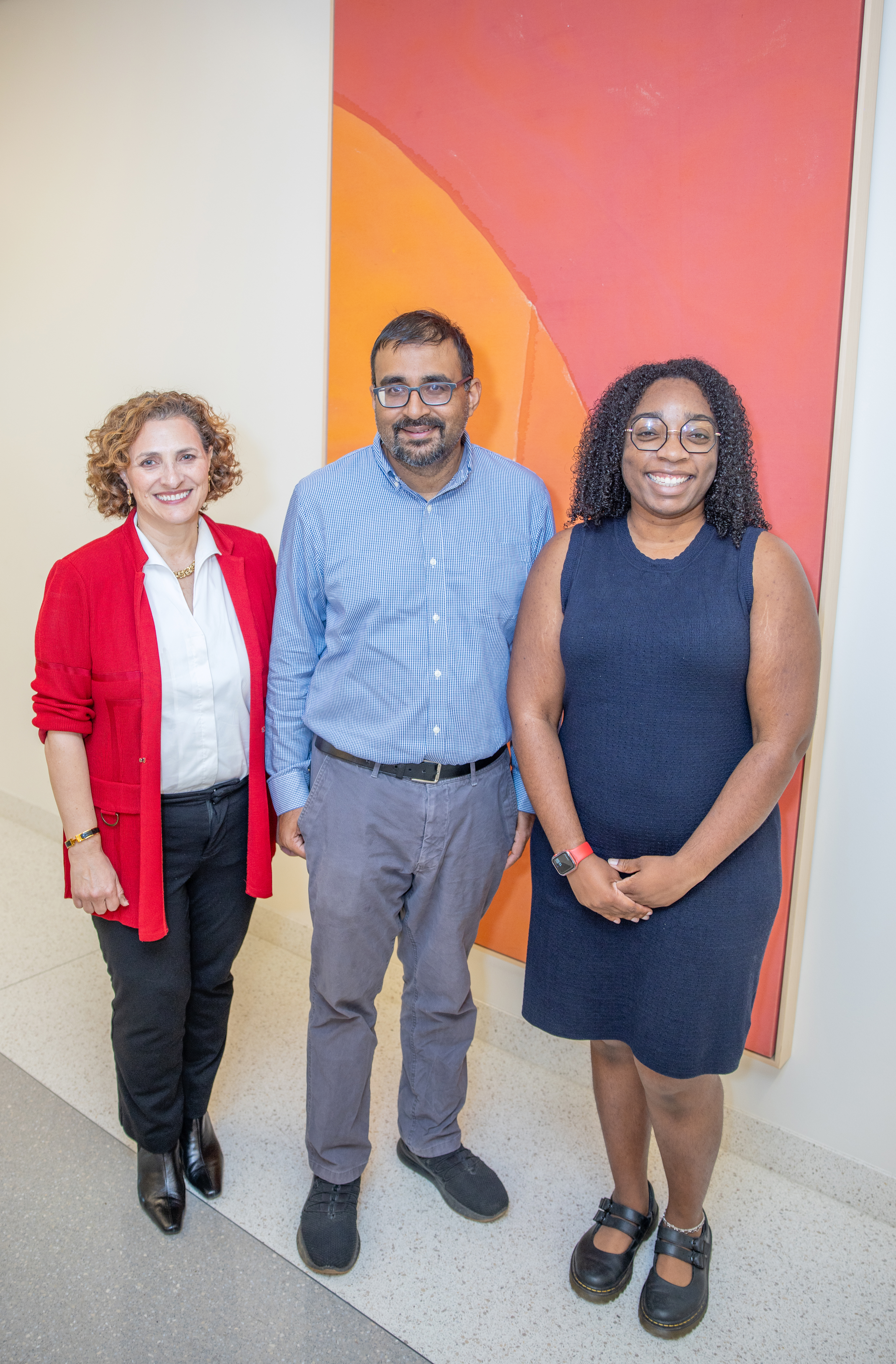
Health Law & Policy Institute Director Jessica Mantel with University of Colorado Law Professor Govind Persad and HLPI Research Scholar Erica Patterson at the University of Houston Law Center.
Dec. 11, 2025 — How should society decide who gets critical medical care when resources run short? That question was at the heart of a recent interactive presentation by Professor Govind Persad from the University of Colorado Law School. The event, held recently, was part of the University of Houston Law Center’s Health Law and Policy Institute Speaker Series.
Titled “Fairly Allocating Scarce Medical Resources: Should We Consider Age and Health Status?”, the talk examined whether lifesaving options, such as donor organs and ECMO machines, should go to those who are most likely to benefit or those most disadvantaged.
Persad, a nationally recognized bioethicist, first turned to health status as a key factor in allocation decisions. He shared that his own mother died of cancer, and he drew on that experience to highlight the emotional weight behind the choice.
After polling the audience and seeing no clear consensus, he shared his own opinion. “I actually do think somebody who has stage 4 cancer should get lower priority for a transplant,” he said. “If you have advanced cancer, you have poor odds of a treatment working, of surviving for a long time, and, even if it does work, you're going to be in pain and have various pretty severe functional limitations.”
Age is another complex factor in allocation decisions.
"Younger age of treatment is associated with greater odds of success,” he said, noting that policymakers often gravitate toward age-based prioritization even when it raises discomfort about whose lives are valued most.
Audience members challenged the assumption that older patients should be deprioritized, pointing to deeper social ties and higher reported life satisfaction among older adults.
He acknowledged that research supports this perspective. “Literature suggests that people's self-reported life satisfaction tends to increase with age,” he said. “Another empirical study suggests the older somebody becomes, the more interestingly interwoven they are in [the] lives [of others].”
These competing values, he said, make age-based rules ethically fraught even when they align with predicted medical benefits.
Persad proposed a more justice-oriented approach. Rather than ignoring benefit differences—or allowing them to dictate all priorities—he argued for carving out a portion of scarce resources to improve access for people disadvantaged by primary allocation rules.
“[My goal] is to narrow health disparities,” he said. “There are people whose medical conditions shorten their survival [due to socioeconomic disadvantage, and] we don't want to pile disadvantage on top of disadvantage.”
This approach, he suggested, could help counterbalance the inequities built into predictors like age, comorbidity, or survival scores. But he cautioned that U.S. antidiscrimination doctrine may limit such policies, as courts often prioritize maximizing medical benefit when assessing fairness.
Much of the research Persad shared at the talk will appear in his forthcoming book “Fair Allocation in an Unfair World” with Cambridge University Press. The book expands on the ethical tensions and policy challenges raised during the event.
Persad left the audience with a sobering thought: Fair allocation isn’t only about maximizing survival. It’s also about deciding what kind of injustice society is willing to tolerate—and what kind it is not.


