

Who Owns the Heat? Expert Warns Unclear Property Rights Slowing Geothermal Energy Development
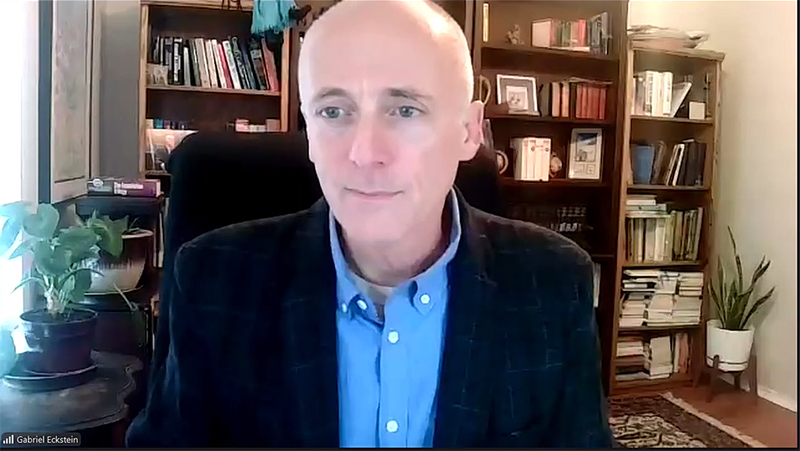
Gabriel Eckstein, a law professor and director of the Energy, Environmental, and Natural Resource Systems Law Program at Texas A&M University School of Law.
Feb. 4, 2025 — Ambiguous property rights are among the biggest obstacles to expanding geothermal energy in the United States, a nationally recognized energy law expert said during a recent University of Houston Law Center webinar. The event was hosted by UHLC’s Environment, Energy and Natural Resource Center. Qaraman Hasan, a research scholar, and Chinonso Anozie, an assistant professor of law –both with the EENR Center – served as co-moderators at the webinar.
Gabriel Eckstein, a law professor at Texas A&M University School of Law, examined issues surrounding geothermal ownership in his talk, “Owning Heat: Legal and Practical Challenges to Allocating Ownership Rights in Geothermal Energy.”
“When we talk about geothermal energy, we’re talking about a non-physical thing…Thermal energy is simply temperature,” said Eckstein, who is also the director of the Energy, Environmental, and Natural Resource Systems Law Program at A&M. “It’s the heat in the rock, the heat in the water, the heat that is underground. When you’re going down to the center of the Earth, you’re down to over 10,000 degrees Fahrenheit, which is about a little more than what the heat of the sun currently is.”
Even better, it’s a renewable source of energy.
“It’s nearly limitless in the sense that it's being replenished continuously,” Eckstein said. “You drill anywhere. Anywhere around the world. I don’t care if it’s in Antarctica or the bottom of the ocean. If you drill deep enough, you’re going to hit heat.”
Geothermal energy can be used to heat homes and buildings, power entire neighborhoods through applied infrastructure, and generate electricity.
Eckstein noted that despite the Earth containing an estimated 50,000 times more heat energy than all global oil and natural gas reserves combined, geothermal energy accounts for just 0.4% of total U.S. electricity generation. He added that unclear ownership rules for subsurface thermal energy have discouraged both public and private investors.
“Markets don’t function without property rights,” Eckstein said. Unlike oil, gas and water, resources with well-defined and established legal rules and regulations, underground heat can’t be captured or contained in the same way. That makes it difficult to fit geothermal energy into existing laws, which in many states were developed with fossil fuels in mind.
Eckstein warned that private ownership models could create significant legal conflicts, especially where subsurface reservoirs span multiple parcels of land.
He also cautioned against applying traditional doctrines such as private ownership and the rule of capture, which allows landowners to extract resources beneath their property, to geothermal energy. Fragmented property rights, he said, could lead to costly litigation and unsustainable extraction.
Instead, he suggested, public ownership or open-access models, paired with clear permitting systems, could offer greater regulatory certainty while still encouraging development and investment.
“This is one of the most promising clean energy resources we have,” Eckstein said. “The challenge is aligning the law with the science.”
To watch a recording of the webinar, click on this video link.

