

Law Dean Stefanie Lindquist Shares New Research on Declining U.S. Appellate Caseloads and Explains Why That Matters at UH Law Colloquium
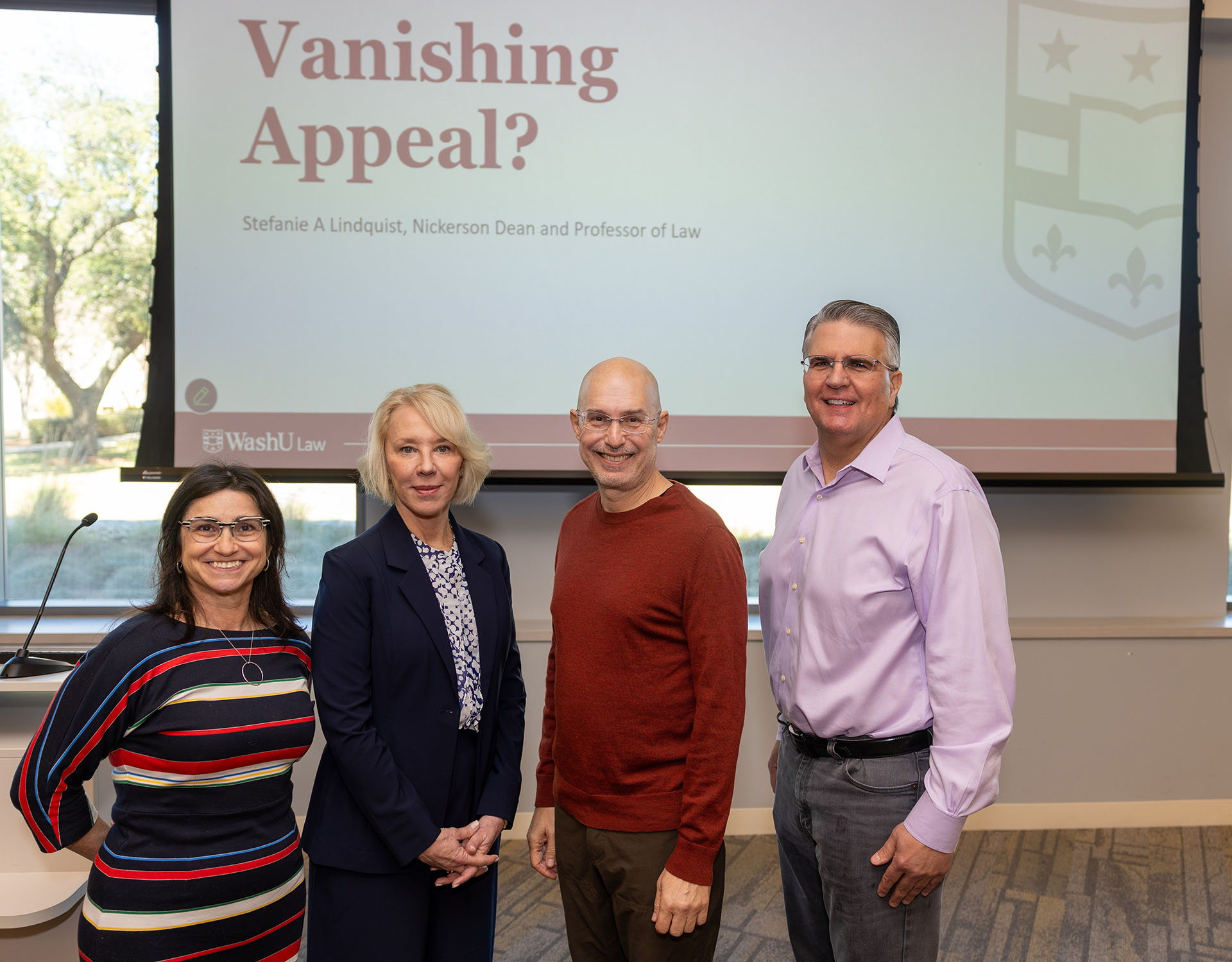
Summary: Stefanie A. Lindquist, Nickerson Dean and Professor of Law and Political Science at Washington University in St. Louis, visited the University of Houston Law Center to present new research from her project “The Vanishing Appeal,” which examines the long-term decline in federal appellate filings and what that trend may mean for access to justice.

April 9, 2026 — A leading scholar of judicial behavior told a University of Houston Law Center audience that federal appeals courts are seeing significantly fewer cases, a trend she didn’t set out to find but one she believes raises concerns about access to justice.
Stefanie Lindquist, Nickerson Dean and Professor of Law and Political Science at Washington University at St. Louis, shared new findings from her new paper and ongoing research project called “The Vanishing Appeal”, as part of UHLC’s 2026 Colloquium/External Speakers Series. She uncovered the trend while updating her earlier research from 2007, which examined changes in appellate court behavior.
“In the process of updating the paper, I discovered an interesting trend, which I decided to call the vanishing appeal,” Lindquist said, adding that federal appellate filings have been falling almost steadily since 2006, declining by about 26,000 cases from their 2005 high. Before that, filings rose in step with U.S. population growth.
“That is to be expected, right? The more people there are, the more likely you're going to have litigation,” Lindquist said, before noting that the two trends are now moving in opposite directions, with appeal numbers dropping to levels last seen in the 1990s.
“Along with that…is the vanishing appellate process in which U.S. Courts of Appeals are granting fewer and fewer cases oral argument,” she added. “And they are publishing fewer and fewer of their opinions in the Federal Reporter.”
Lindquist warned that publication practices shape how precedent works.
“And that matters because then you end up with two large bodies of case law — one is unpublished, one is published…exactly how you use that precedent going forward depends upon the circuit you're in because the rules differ on whether you can cite unpublished opinions,” she explained. “That's something to think about.”
Lindquist noted that the trend aligns with earlier documented phenomena like the vanishing trial, declines in certiorari petitions to the U.S. Supreme Court, and declining appeals in state supreme courts.
“Perhaps litigants are [not appealing], where they see certainty in the outcome because there is a predominant ideological predisposition on the circuit, they're not as likely to appeal,” she theorized. “But where they see uncertainty in the draw, they are more likely to appeal.”
Throughout the discussion, Lindquist as well as audience members brainstormed about different potential systemic contributors, such as economic and complexity barriers to litigation, the increase in trial delays, greater reliance on arbitration, political ideological shifts and shrinking access to justice.
“Appellate filings are higher in larger circuit courts and more populated circuits, but they're also higher in circuits with greater ideological variance,” Lindquist said.
She said the next phase of the project will use AI tools to incorporate detailed case-level data to better understand procedural factors, doctrinal shifts and qualitative interviews with judges.
At conclusion, Lindquist shared that France, Germany and UK are also experiencing declining caseloads.
“We want our courts to be efficient,” Lindquist said. “We want them to be available so that disputes are resolved in the appropriate forum rather than on the streets or whatever. So, if there's a systematic change over time across countries, that is super interesting.”
Lindquist is widely recognized for her scholarships, which includes her book, “Measuring Judicial Activism,” the first work to quantitatively define the oft-used term. She was also awarded the Robert Birkby Award for Excellence in Teaching Political Science during her tenure at Vanderbilt University and was named professor of the year at the University of Georgia.

