

UH Law Colloquium Speaker Dean Grinvald Digs into the Myth Behind Trademark ‘Policing’
Quick summary: Dean Leah C. Grinvald visited the University of Houston Law Center to discuss her article, “Holstering Trademark’s Duty to Police,” and the misunderstanding behind trademark enforcement practices.

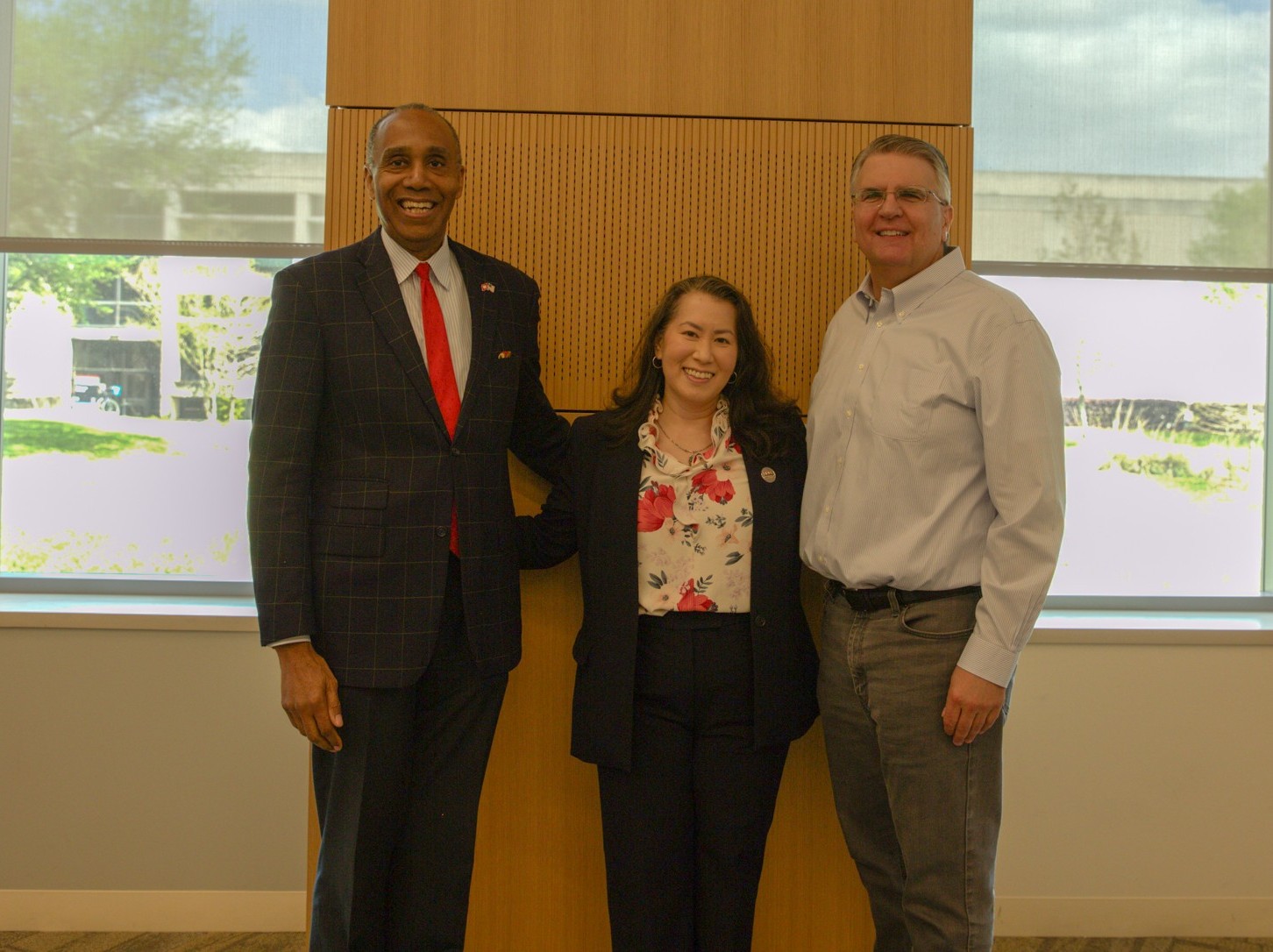
May 27, 2026 — Trademark law has long been accompanied by a warning that brand owners must vigilantly enforce their rights or risk losing them. But that warning, according to research presented as part of the University of Houston Law Center’s 2026 Colloquium/External Speaker Series, reflects a misunderstanding of how trademark law works with real consequences for businesses and consumers.
Leah Grinvald, dean of the William S. Boyd School of Law at the University of Nevada, presented a talk about her article, “Holstering Trademark’s Duty to Police.” The paper argues that the commonly invoked “duty to police” is not a legal obligation but a mischaracterization.
The article, co-authored with University of North Carolina School of Law Professor Deborah Gerhart and Santa Clara University of Law Professor Eric Goldman, draws on years of research about trademark enforcement practices, particularly for small businesses and individuals.
For Grinvald, the issue is personal. She recounted her family’s experience running a restaurant in Chinatown during her childhood and having to deal with trademark issues. “Some disgruntled employees left the restaurant and started a competing business with a confusingly similar name,” she said. “My family, being immigrants, didn’t know what to do. That has really stayed with me throughout my life.”
She said the purpose of the article is to clarify how trademark law is often misunderstood and overstated, not just by civilians, but also by legal professionals. The current draft, Grinvald explained, “is primarily descriptive in nature and tries not to break new ground but restates the [current] law to build a foundation for more normative policy.”
The paper is centered on the authors’ rejection of the idea “duty to police,” which has expanded far beyond its legal foundations. “Trademark owners do not have a duty to enforce their rights,” she said. “They’re truly free to ignore infringers, particularly if they’re making a non-trademark use of their marks.”
Instead, she emphasized that the status quo creates a potential consequence for inaction, not a strict legal requirement. Even the consequences, she notes, are limited in action. “Forfeiture in trademark law, for example, is not happening very often,” she said. “It is reserved for really egregious behavior.”
Despite the low-risk reality, over-enforcement persists. Grinvald and her co-authors list many psychological and structural factors to explain this, including what she described as the tendency for owners to overvalue their marks for fear of losing them. “Owners think they have something to protect, which makes forfeiture really scary,” she said. “Their owners may think they have the potential to become the next Apple. And I want to acknowledge that trademarks can be valuable, but not all trademarks are.”
The responsibility, though, does not fall solely to business owners. Legal advice also plays a role. Citing a study conducted by William T. Gallaher titled “Trademark and Copyright Enforcement in the Shadow of IP Law,” Grinvald claimed that attorneys often advise their clients to go after weak claims of trademark infringement, encouraging aggressive enforcement strategies.
Legal doctrine creates few downsides to this over-enforcement, deepening this issue. “There are no legal consequences to either the attorney or the trademark owner for shooting first, asking questions later,” she said. “Lawyers will send out lots and lots of cease-and-desist letters, just based on a cursory review of the alleged infringer’s action.”
The key reform proposed by Grinvald and her co-authors is aimed at narrowing the gap between doctrine and practice. “Our first suggestion is simply to retire the phrase ‘policing duty’ because it is inherently misleading,” she said, hoping to abandon the language that has fueled the confusion. They also urged the courts to take a more active role in shaping this behavior. “If judges can better communicate the extraordinary nature of the remedy, then trademark owners will make smarter decisions,” said Grinvald. “They should be more emphatic and combat overzealous enforcement when they see it.”
As part of the 2026 Colloquium/External Speaker Series, Grinvald’s presentation sparked a discussion with students and faculty on topics including the importance of semantics and the likelihood of market expansion. These events offer students the opportunity to engage directly with developing scholarships, contributing feedback that may even shape the final version of Grinvald’s work.

